

By Myka Kennedy Stephens February 9, 2026
Listen to the Podcast Version Watch the YouTube Version
When I first started as a seminary librarian with the responsibility to direct a theological library, the dean gave me a mandate: right-size the collection. The library had grown from modest beginnings in the 1820s and was a decade away from its bicentennial. The physical size was over 200,000 bound volumes, including books, periodicals, and special collections. In comparison to other seminaries with similar enrollment, less than 100 students and declining, the library was oversized for the school. While to some it might have appeared a bit overgrown, this was a curated collection of materials to which former professors and students had contributed to over generations. Previous librarians had acquired the personal libraries of important collectors and scholars. It told the story of the school, of the professors who had come before, of the subjects that were taught, and of the viewpoints that were thought important to preserve.
What business had I, a newcomer to this community, making decisions that would significantly change the shape and size of this collection? I felt both entrusted with great responsibility and intruding on a story that had begun long before me.
Over the course of four years I proceeded to right-size the collection, as I had been asked to do. And in the process, I discovered how important relationships are. There were many relationships to attend to through the course of this work: with the seminary’s administrators and trustees, with my faculty colleagues, with the library’s staff members, with students and alumni/ae, with the library’s patrons from the surrounding community, with the collection, with the seminary’s history, with the library building, with the environment and, surprisingly, with myself.
Margaret Wheatley explores the fundamental nature of relationships in her groundbreaking classic, Leadership and the New Science. Drawing on quantum physics, Wheatley describes a world in which nothing exists in isolation; everything takes shape in and through relationship. In a world that is defined and navigated by relationships, apparent polarities soften, revealing a web of complex and interconnected threads. In this web, relationship provides connection and potential, pathways to endless possibility.
Attendant Leadership sits on a foundation of relationality, the state of being part of an interconnected web of relationships. When we begin to understand that we are part of an interconnected web, we see that we do not exist in isolation. Hundreds, if not hundreds of thousands, of invisible threads link us to people, places and more. We feel the effects of changes, decisions, and events involving the people and things we are linked to, just as the changes, decisions, and actions in us are felt by others. When we think about our leadership, relationality takes on greater importance.
As leaders with agency, we begin to see how our actions influence our relationships and are influenced by those we are in relationship with. When we exercise power as attendant leaders, we feel a responsibility to act in ways that avoid or reduce harm across this web, and to pursue service, justice, and peace wherever we can.
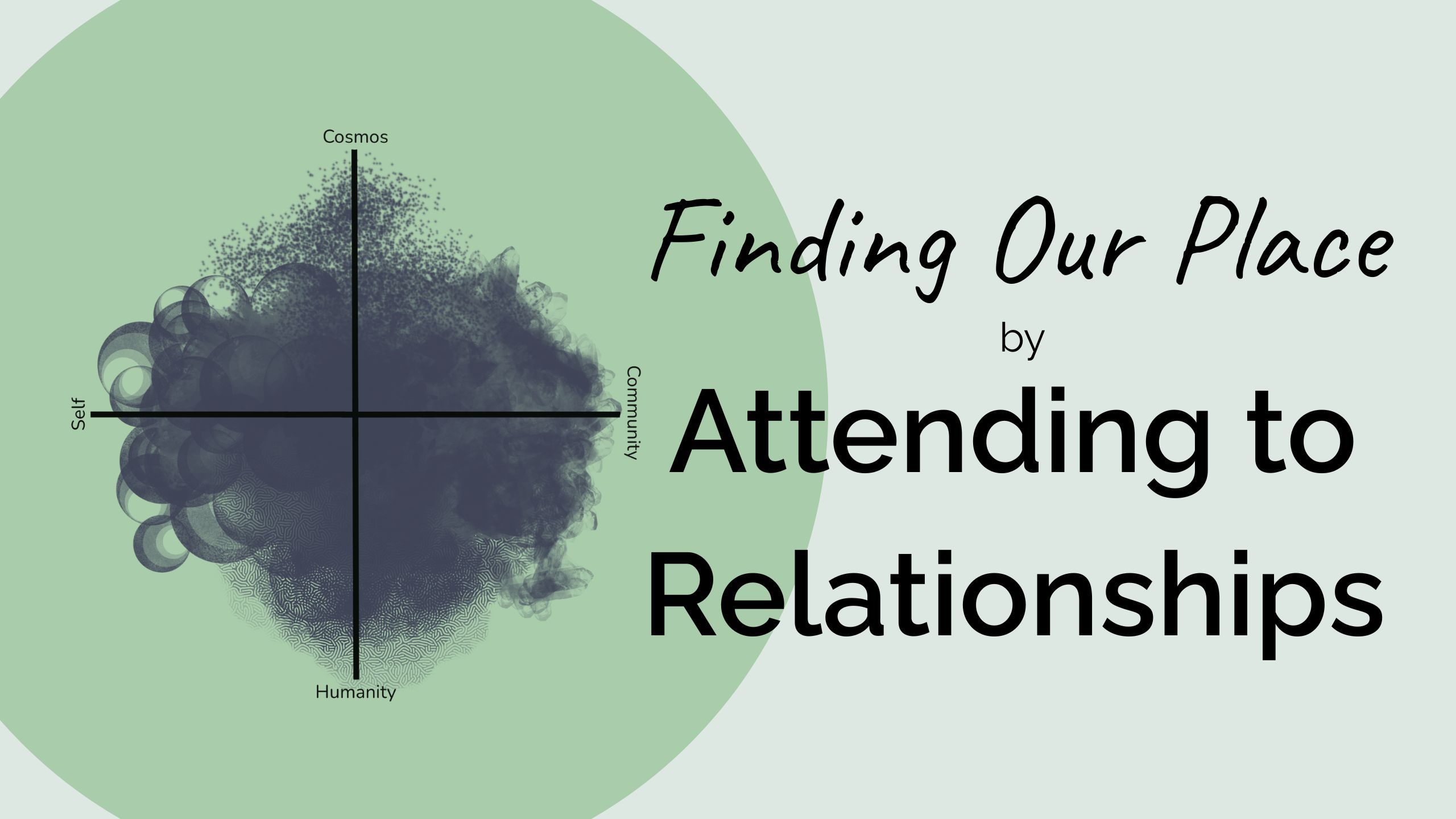
Visualizing this interconnected web of relationships is complex and messy. It is self-organizing chaos, to borrow another visual from Wheatley’s work. In order to make sense of it in a way that lends to use in a visual map, I’ve grouped relationality for Attendant Leadership into dimensions. Both trace movement between the micro and macro, from what is individual or local to what is universal or global.
One dimension of relationality explores the scope of our relationships with self on one side and community at the other side. The movement between micro and macro for relational scope takes us between our individuality and what it is to be in community. The attention to relationship with self pertains to self-awareness and identity. For example, how we attend to our energy, identity, trauma histories, and bias before walking into a meeting. The attention to relationship with community involves recognizing the diversity of communities to which we belong and understanding our interconnected roles in each. For example, how we hold our roles as colleague and supervisor, or as a manager, director or dean and also a member of a wider staff, faculty or consortium.
The second dimension of relationality explores the depth of our relationships with humanity on one side and the cosmos on the other. The movement between micro and macro for depth takes us between our human experience and what exists around and beyond our immediate human systems: our planet, the universe, the past and future. The attention to relationship with humanity helps us to understand the systems that we create and participate in as well as our role in preserving them or changing them. For example, a human system that librarians regularly relate to is the controlled vocabulary used for subject headings in bibliographic records. The attention to relationship with the cosmos helps us to see our involvement in and impact on systems and dynamics that are much larger than humanity. For example, how we balance the environmental impact of print collections and the digital infrastructure needed to maintain large databases and LLMs.
When you look at the illustration of Attendant Leadership that is beginning to take shape with these micro and macro lenses, you see a two-dimensional matrix. I am aware that this is an over-simplification of the complexity of relationality in Attendant Leadership. The diagram risks suggesting fixed poles and tidy categories, but each endpoint is really a cluster of many different relationships. I use this two-dimensional model not because it captures the full complexity of relationality in life and leadership, but because it helps me notice where my attention is going—and where it isn’t—when I make leadership decisions.
I started off recalling when I was asked to right-size a mature theological library collection so that it more closely matched the needs and available resources of a shrinking theological school. Leading that effort involved maintaining many community relationships, as you might expect. Many voices needed and wanted to be included in the decision-making process. Library staff felt the burden of additional work and needed support. The sight of emptying shelves elicited various responses from patrons: from concern to outrage, from anxiety to indifference.
It would have been easy to stay in that space, attending primarily to these communal relationships and relying on them to provide me all the feedback I needed. Had I done that, the result would have been less balanced. Attending to humanity invited me to explore how the knowledge and information held in the collection could continue to serve human flourishing, even if we could no longer maintain research-level depth in many subject areas. Attending to the cosmos invited me to consider the environmental impact of deselection and to seek creative ways to reuse and repurpose items that could not be sold or given a new home. Attending to self, as uncomfortable as it was, helped me to manage this large project with grace for my own limitations, space to make mistakes, and permission to grieve what the collection had been so that I could help it become something new.
Taken together, these dimensions of relational scope and relational depth became a way of finding my place in a much larger web: with myself, with my communities, with humanity, and with the more-than-human world. As you think about your own leadership context, where do you notice yourself most strongly attending right now: self, community, humanity, or cosmos? And what might shift if you treated your next difficult decision as an opportunity to re-locate yourself within that web of relationships?